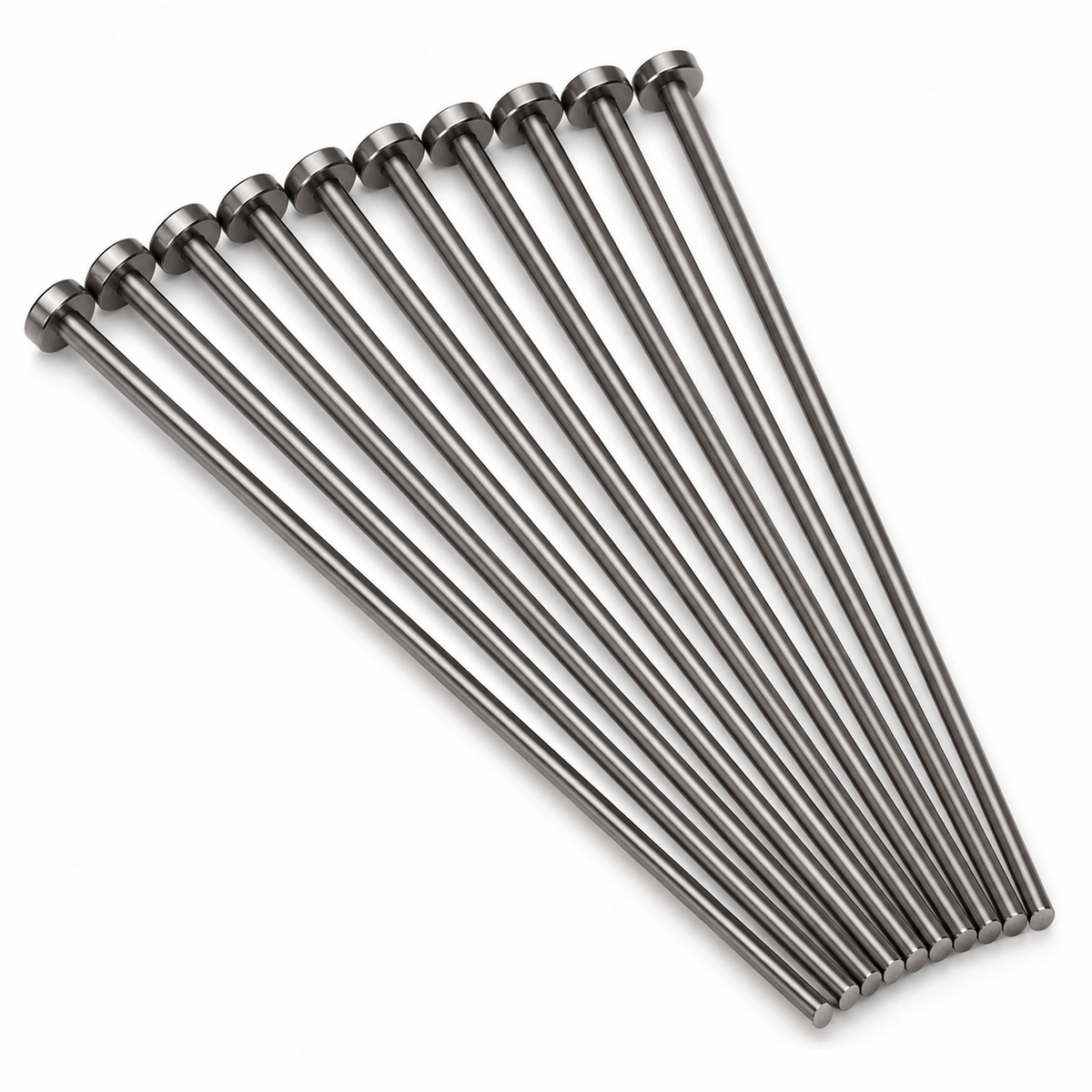


Through-Hardened Ejector Pins — Pack of 10
Standard-part returns: request authorization within 14 days after delivery; item must be unused, uninstalled, undamaged and in original packaging. Review the full return policy.
Need a non-standard size? Request a Quote →Through-hardened ejector pins, sold in packs of 10. Sizes are given as diameter × length in millimetres.
Through-hardened or nitrided — which do you need?
We stock both, and the choice is not about which is "better". They fail differently.
| Through-hardened (this page) | Nitrided SKD61 | |
|---|---|---|
| Hardness | Hard all the way through — see the note below | 700–900 HV case over a 35–42 HRC core |
| Wear resistance | Consistent, and it stays that way after cutting or regrinding | High at the surface only; a cut face is soft |
| Toughness | Lower — more likely to snap than to bend | Higher — the soft core absorbs shock and side load |
| Best for | Abrasive and glass-filled resins, high shot counts, pins that get cut or reground | General work, long thin pins, tools with any misalignment |
The practical rule: if your pins are wearing out, go through-hardened. If they are breaking, go nitrided — a harder pin will break sooner, not later. See the nitrided SKD61 pins.
Hardness — and why we confirm it rather than print one number
"Through-hardened" covers two different materials, and the hardness follows the steel, not the label:
| Material | Typical through-hardness |
|---|---|
| SKD61 / H13, vacuum hardened | 48–52 HRC |
| SKH51 high-speed steel | Higher, into the low 60s HRC |
Be sceptical of any supplier offering an H13 pin at 60 HRC through-section. H13 is an air-hardening hot-work steel; taken much past the low 50s it loses the toughness that made it worth using, and most reputable makers stop around 52. A genuine 60+ HRC pin is high-speed steel and is priced accordingly.
We confirm the material and the measured hardness for your batch in writing before shipping, and a hardness report can be supplied with the order. Tell us the resin, the filler content and roughly how many shots the tool runs a year, and we will tell you which grade we would fit rather than leaving you to guess from a catalogue number.
Why these cost more than the nitrided pins
The premium is mostly material grade, not process time. A through-hardened pin starts from a higher-specification bar and is harder to grind once treated, so cost runs roughly two to four times nitrided SKD61 at the same size. We price from actual supplier cost rather than smoothing it into a tidy ladder.
If your application does not need the wear resistance, the nitrided pins are cheaper and tougher — we would rather tell you that than sell you the dearer one.
Cutting and regrinding
This is where through-hardened pins earn their price. A nitrided pin cut to length exposes soft core material at the cut face; a through-hardened pin is the same hardness at the cut as it was in the middle. If your shop routinely cuts pins to fit or regrinds worn faces rather than replacing them, through-hardened will outlast nitrided by a wide margin.
The same hardness makes them harder to cut. Use an abrasive wheel or wire EDM, not a hacksaw.
Specifications
| Condition | Vacuum through-hardened |
| Hardness | Confirmed on order — see the note above |
| Diameters | Ø1.5, 2, 2.5, 3, 4, 5, 6, 8 |
| Lengths | 100–250 mm |
| Pack quantity | 10 pieces |
| Origin | Danyang, Jiangsu, China |
Larger and longer sizes
Ø10, Ø12 and Ø16, and lengths up to 500 mm, are all made — they are just too heavy to ship sensibly at a flat parcel rate. Request a quote for those and we will price the freight properly against your destination, which usually works out better for you than a flat rate would.
Choosing a size
Pins are supplied at nominal length and cut to fit at the head end. Measure the plate stack rather than the old pin if the old one was already cut. If you are unsure whether you need through-hardened or nitrided, describe the application and we will give you a straight answer — including telling you when the cheaper nitrided pin is the better part.
Shipping
International freight is calculated on packed chargeable weight. Pins are packed in rigid tubes. See Shipping & Delivery for destinations and transit times. Import duties and taxes are the buyer's responsibility — please read the duties section on that page before ordering.
- Material grade
- SKD61 / H13 or SKH51; confirm selected grade
- Hardness / load grade
- Through-hardness confirmed for selected material
- Surface treatment
- Vacuum through-hardened
- Key tolerance
- Confirm controlling dimensions before ordering
- Metric specification
- Diameter × length (mm)
- Package quantity
- 10 pieces per pack
- Single-piece weight
- To be confirmed
- Package weight
- To be confirmed
- Country of origin
- Danyang, Jiangsu, China
- Processing time
- Varies by specification; confirm before ordering when timing is critical
- International freight
- Quoted from packed chargeable weight; carrier transit time is estimated separately
- Typical application
- Abrasive resins, high shot counts, cutting and regrinding
- How to select
- Choose diameter and overall length, then confirm material and hardness.
- Check before ordering
- Diameter, overall length, head geometry, tip requirement and material grade
- Non-standard dimensions
- Submit an RFQ with a drawing, photo or measured dimensions