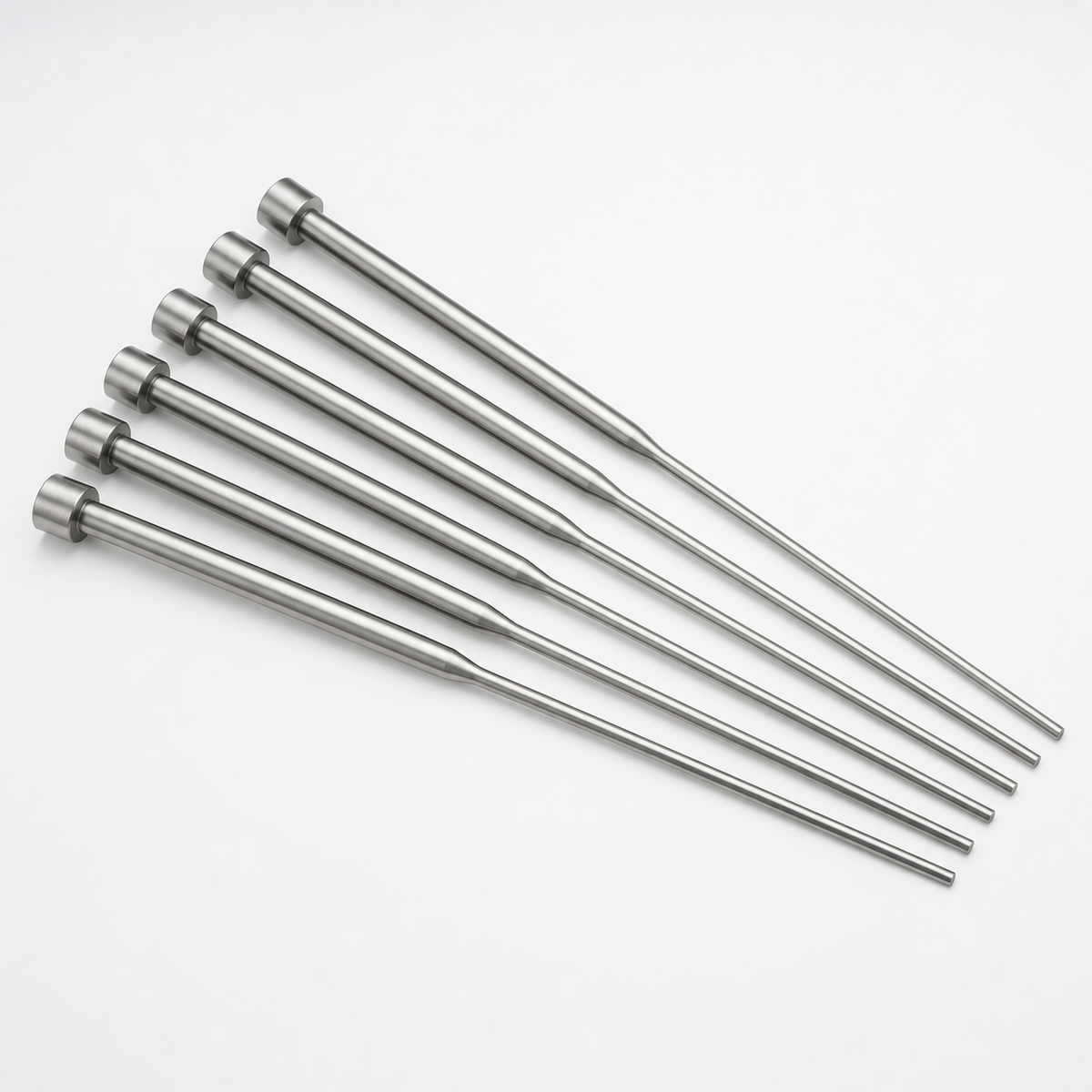


SKD61 Nitrided Stepped Ejector Pins — Pack of 5
Standard-part returns: request authorization within 14 days after delivery; item must be unused, uninstalled, undamaged and in original packaging. Review the full return policy.
Need a non-standard size? Request a Quote →SKD61 vacuum-hardened, nitrided stepped ejector pins for injection-mold maintenance and replacement. Sold in packs of 5. Stepped pins let you eject from a small feature without running a fragile thin pin the whole length of the plate — the tip does the work, the larger shank carries the load and the buckling.
How the size is written
We use the notation P × D × L – N, the same convention used on our custom stepped-pin quotations:
| P | Tip diameter — the working end that contacts the part |
| D | Retention / shoulder diameter — the larger section |
| L | Overall length |
| N | Retention length, from the head-side reference to the step |
| L − N | Effective length of the small-diameter tip |
So P2 × D3 × L200 – N70 is a 2 mm tip on a 3 mm shank, 200 mm overall, with 70 mm of retention length — leaving 130 mm of Ø2 tip. All dimensions in millimetres.
The same tip diameter appears against more than one retention diameter in this range, so always work from the full P × D pair rather than the tip alone. A Ø2 tip on a Ø3 shank and a Ø2 tip on a Ø4 shank are different parts and need different plate holes.
Getting the step in the right place
N is the dimension people most often get wrong when ordering a replacement, because it is the one you cannot measure once the pin is in the mold. The step has to sit inside the plate, not inside the core — if the shoulder lands in the core bore, the pin will not seat and you will either crush the step or open the hole. If the step sits too far back, the thin tip runs unsupported over most of its length and you are back to the buckling problem the stepped pin was supposed to solve.
The practical rule when replacing: pull the old pin, measure from the head face to the change in diameter, and give us that number as N. If the old pin is broken at the step — which is where they usually break — measure the plate stack instead and tell us the thicknesses; we will work N back from that.
Why thin tips are not cheap
A Ø0.8 tip does not cost less than a Ø3 pin because it uses less steel. Long thin ground sections need slower feeds, more passes and more scrap, so cost rises as the tip gets finer and the length gets longer — the opposite of what mass would suggest. That is reflected in the pricing here: length drives price far more than diameter does.
Specifications
| Material | SKD61 (JIS G4404), equivalent to H13 / 1.2344 |
| Treatment | Vacuum hardened and nitrided |
| Case hardness | 700–900 HV on the nitrided surface |
| Core hardness | 35–42 HRC |
| Tip diameters (P) | Ø0.8, 1.0, 1.2, 1.5, 1.8, 2.0, 2.5, 3.0 |
| Retention diameters (D) | Ø3, Ø4 |
| Overall lengths (L) | 150, 200, 250 mm |
| Retention lengths (N) | 50, 70, 75 mm |
| Pack quantity | 5 pieces |
| Origin | Danyang, Jiangsu, China |
A note on how nitride hardness is quoted
A nitrided case is quoted in Vickers (HV), not Rockwell C. The case is only a few hundredths of a millimetre deep, so a Rockwell C indenter pushes through it into the softer core and reads low — any nitrided pin sold with a single "60 HRC surface" figure is quoting a conversion, not a measurement.
Core hardness is a genuine HRC figure and is the one that matters for whether a stepped pin bends or snaps at the shoulder. We confirm the measured case and core values for your batch in writing before shipping, and a hardness report can be supplied with the order. If your incoming inspection tests to a specific standard, tell us which and we will make sure the certificate matches it.
If you need a fully hardened stepped pin instead — SKD61 vacuum hardened through-section, roughly 48–52 HRC, for abrasive or glass-filled resins — ask and we will quote it. It wears better and tolerates shock less well, which at the step is a real trade rather than an upgrade.
Cutting to length
These pins are supplied at nominal length and are normally cut and fitted at the head end. Note that the nitrided case is hard and shallow — cutting exposes unnitrided core material at the cut face, which is fine at the head but is not something you want at the working tip. If you need a finished length rather than a blank, tell us and we will supply it cut and faced.
Need a size that is not listed?
Other P / D combinations, head diameters and thicknesses, double-step and three-section pins, and lengths outside this range are all made to order. Request a quote on the custom stepped pin page with your P × D × L – N, or send a photo of the broken pin next to a caliper — that is often enough to start.
Shipping
International freight is calculated on packed chargeable weight. Long thin pins are packed in rigid tubes; see Shipping & Delivery for destinations and transit times. Import duties and taxes are the buyer's responsibility — please read the duties section on that page before ordering.
- Material grade
- SKD61
- Hardness / load grade
- Confirm before ordering
- Surface treatment
- Vacuum hardened and nitrided
- Key tolerance
- Confirm controlling dimensions before ordering
- Metric specification
- P × D × L – N (mm)
- Package quantity
- 5 pieces per pack
- Single-piece weight
- To be confirmed
- Package weight
- To be confirmed
- Country of origin
- Danyang, Jiangsu, China
- Processing time
- Varies by specification; confirm before ordering when timing is critical
- International freight
- Quoted from packed chargeable weight; carrier transit time is estimated separately
- Typical application
- Small-feature ejection with a larger load-bearing shank
- How to select
- Match tip diameter, shank diameter, overall length and retention length.
- Check before ordering
- P, D, L, N, effective tip length and step position
- Non-standard dimensions
- Submit an RFQ with a drawing, photo or measured dimensions